
The Revolution of 2011, Case Study: Egypt
- Political Analysis
Ioakeim Ioakeim
- 0
- 15 minutes read
Abstract
The main research question of this article is how the Egyptian revolution of 2011 fits into Paul Routledge’s anti-geopolitical theories. The period 17 December 2010 to 11 February 2011 has been selected, with a brief overview of the Tunisian uprising and a more in-depth focus to the Egyptian revolution. Most of the attention of this paper is therefore devoted to the Egyptian revolution and does not examine its aftermath. The methodological framework is based on four of Routledge’s main concepts: 1) geopolitics from above and below 2) counter-hegemonic struggle 3) realms of anti-geopolitical struggle and 4)globalizing anti-geopolitics. Furthermore, the paper draws on a wide range of primary sources, such as official international organization reports, and secondary sources, including academic journal articles and mainstream media analyses. The article is divided into six parts 1)Introduction, 2)Routledge’s anti-geopolitics theory, 3)Arab Spring Historical Background, 4)Egypt in the context of the Arab Spring 5)Implementation of Routledge’s Theory into the Egyptian revolution case, and 6)Conclusion.
Introduction
The Arab Spring of 2011 was one a major turning point in the contemporary Middle East, as popular uprisings challenged entrenched authoritarian regimes with widely different outcomes. In Egypt, the scale and speed of the revolution, culminating in the fall of Hosni Mubarak, surprised many observers and generated extensive scholarly debate. This paper examines how the Egyptians challenged the hegemonic rule of Mubarak’s regime by applying Routledge’s anti-geopolitical framework, which highlights how ordinary people resist state and elites power.
Routledge’s anti-geopolitics theory
According to Routledge, geopolitics is usually viewed ‘from above’, meaning that these concepts are approached from within the traditional ‘imperial’ geopolitical spectrum of the elites. However, anti-geopolitics attempts to present the idea of ‘geopolitics from below’, seen from the point of view of different groups within civil society (e.g. youth unemployment) who are resisting the domination of the state and its elites (e.g. security forces). Furthermore, civil-society actors wage ‘counter-hegemonic struggle’ in two main ways: they challenge material power, specifically the economic (e.g. crony capitalism) and military (e.g. police-state) power of states and global institutions, and they challenge the elite representations (e.g. state media propaganda, where certain people are portrayed in particular ways).
The ‘realms of anti-geopolitical struggle’ unfold across four interconnected realms. In the economic realm, conflicts arise over access to natural resources (e.g. water) and demands for social services (e.g. health care). Second, in the culture realm, movements develop identities and solidarities around classes, etc., and they engage in cultural struggles that focus both on material conditions and needs (e.g. land), as well as on the practices and meanings of everyday life (e.g. community networks). In the political realm, they resist the state-centered view of politics (e.g. community assemblies), question the role of the state (e.g. against security forces) and oppose neoliberal development ideology (e.g. anti-privatization campaigns). Finally, in the environmental realm, movements protect local ecological places and demand fair access to natural resources (e.g. natural gas) that governments use for their own benefit (e.g. through transnational corporations).
Moving on, there is also ‘globalized anti-geopolitics’, meaning that as power itself become globalized-for instance, through multinational companies-resistance also globalizes. These forms of resistance are interconnected and can be divided into two main categories. Localized global actions, occur when people resist in their local places (e.g. cities), generating ideas and tactics that travel to other sites (e.g. countries) and inspire further struggles. This leads to the emerge of ‘globalized local actions’, when these travelling ideas and tactics result in coordinated actions in different locations around a shared issue.
Arab Spring Historical background
In December 2010 a wave of uprisings spread across the Arab world, as citizens in several MENA states protested long-lasting authoritarian regimes, corruption, the lack of social justice etc. Initially mobilized by students, activists and workers, these movements relied heavily on internet platforms to coordinate demonstrations and circulate information. However, they met with the iron fist of these tyrannic states, and in most cases the situation quickly escalated rather than contained, due to the use of tear gas and gunshots against demonstrators.
The trigger came in Tunisia, when Mohamed Bouazizi, twenty-six-years-old street vendor, who set himself on fire in front of the Sidi Bouzid municipal building after he was harass by local officials and the confiscation of cart which was his only source of income. His act sparked nationwide protests that forced the authoritarian President Ben Ali to flee the country. Events in Tunisia generated a domino effect, inspiring uprisings in other Arab states. Some long-standing rulers fell-like Mubarak in Egypt and Gaddafi in Libya-while elsewhere regimes survived or civil wars erupted. Although the Arab Spring raised hopes for a better future, it produced a variety of outcomes, including renewed authoritarianism and protracted conflict.
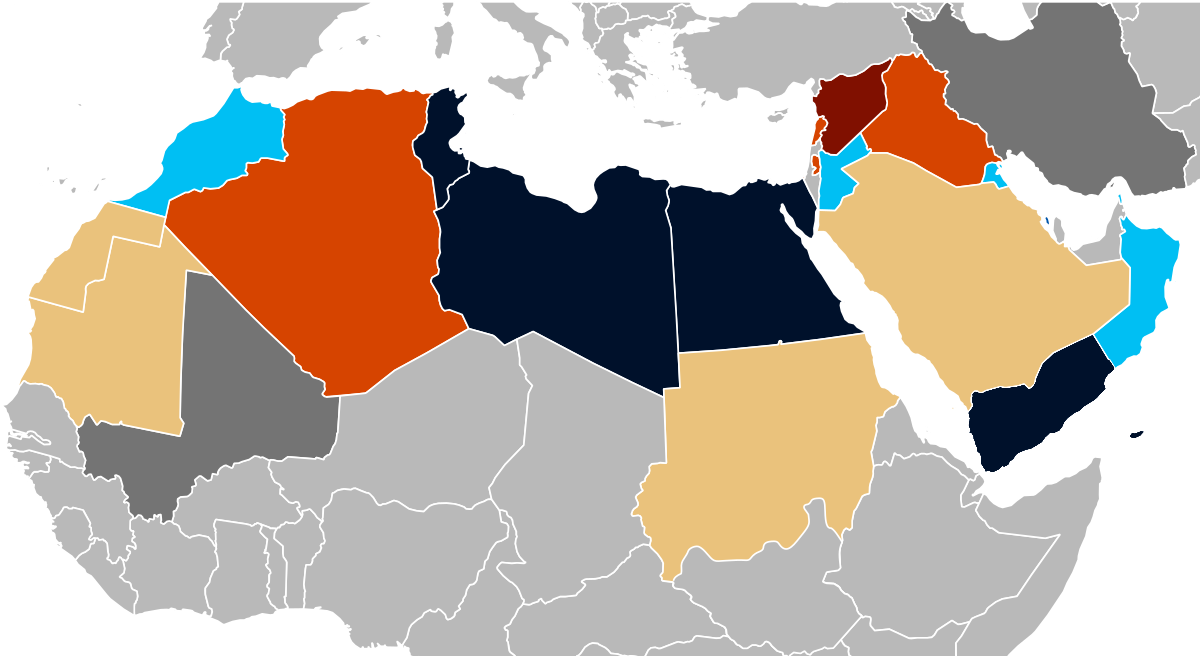
Arab Spring Map in 2011 -Black Color, The Goverment was Overthrown -Navy Color, Minor Counter-protests -Red Color, Armed Riots -Orange Color, Large Urban Protests -Beige Color, Minor Protests -Grew Color, Arab Protests in non-Arab countries |
Egypt in the context of Arab Spring
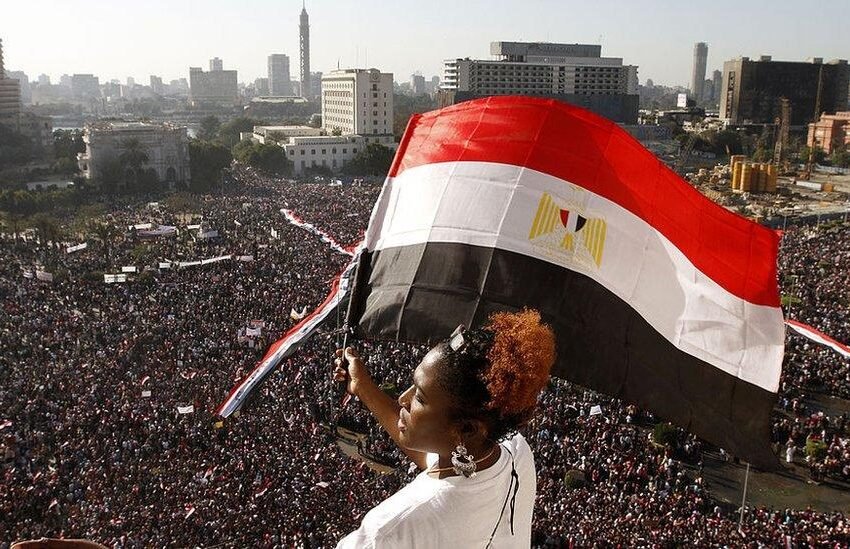
After the assassination of Egyptian president Anwar al-Sadat in 1981, Egypt entered nearly three decades of authoritarian rule regime under Husni Mubarak. Although the regime delivered a degree of economic growth, wealth was highly concentrated among a small elite, deepening social and economic inequalities. On 25 January 2011, a national holiday celebrating the police, mass demonstrations labelled a ‘Day of Rage’ broke out against police brutality, corruption, the repressive police-state apparatus, unemployment, economic despair, and the high prices of food and fuel. Events in Tunisia, especially the fall of Ben Ali following after Bouazizi’s self-immolation, together with the killing of the Egyptian Khalid Sa’id by Egyptian police, helped to motivate Egyptians to mobilize against Mubarak.
Demonstrations took place daily throughout Egypt–most visibly in Cairo’s Tahrir square, and in other cities like Alexandria–and were coordinated largely through social media and activist networks. As repression escalated, the size and determination of the crowds grew, and demonstrations rejected Mubarak’s attempts at partial concessions including dismissing and replacing members of his cabinet, reducing food prices, and promises not to run again for president and to reform the constitution. After eighteen days of continuous protest, Mubarak resigned on 11 February and the Supreme Council of the Armed Forces assumed power, promising a transition to elections. In June 2012 Mohamed Morsi was elected president but in July 2013 he was overthrown by a military coup led by Abdel Fattah el-Sisi. The eighteen-day revolution led to the death of approximately 846 people and the injury of around 6467 others; all the victims of Mubarak’s regime were labelled by the society as martyrs, symbolizing their struggle for freedom against the tyrannic regime.
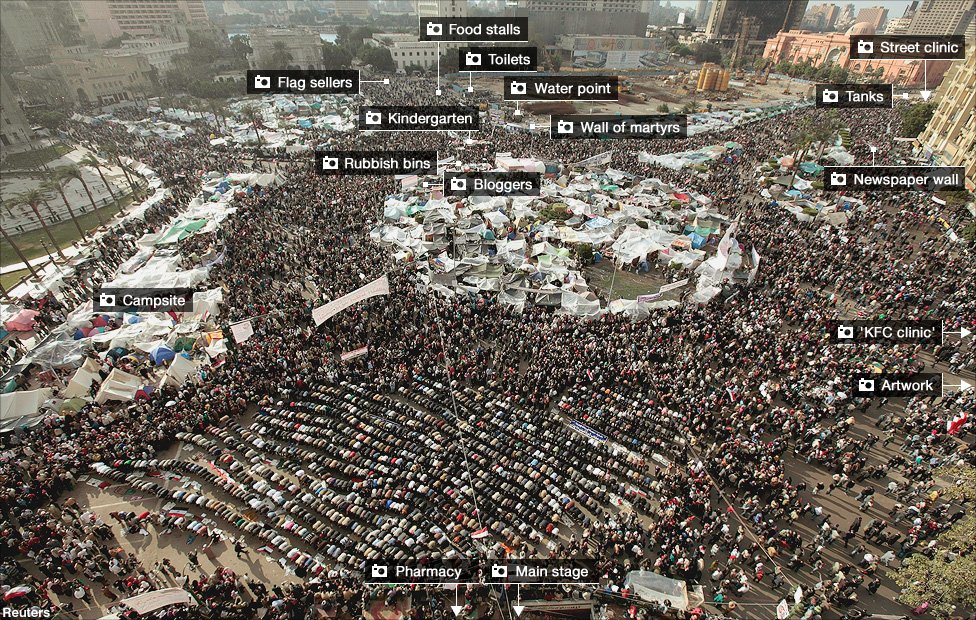
Tahrir Square |
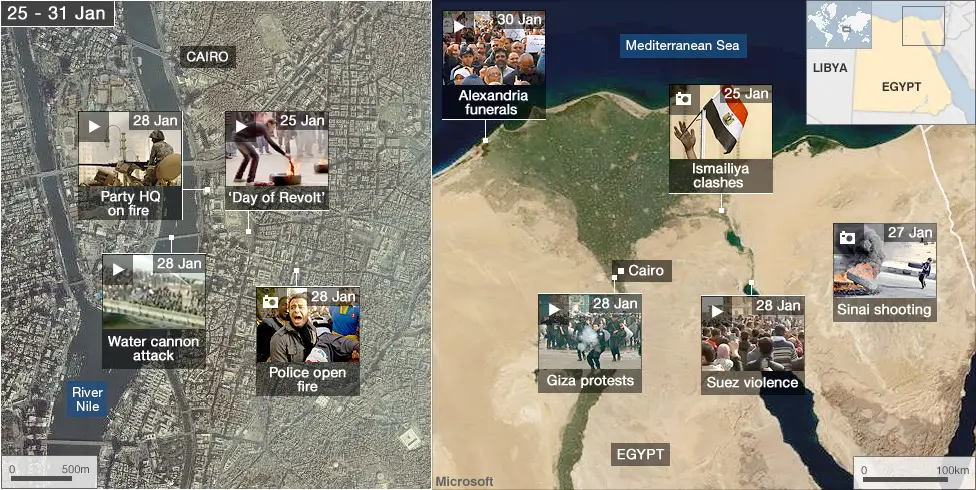 |
| Mapping some of the demonstrations that took place in Egypt |
Implementation of Routledge’s Theory into the Egyptian revolution case
From a perspective of ‘geopolitics from above’, the downfall of Mubarak’s regime was a major shock to the international community, since Egypt appeared to be a strong, stable state with powerful security forces and a growing economy. However, the view of ‘geopolitics from below’ presents a different image of groups who resisted the regime. One such group was young people aged 15-29, among whom unemployment was about 24.5%; an estimated 40-50% of university graduates were unemployed, facing bleak prospects despite formal education.
Mubarak’s regime was challenged through both dimensions of ‘counter-hegemonic struggle’. In terms of ‘material power’, on the military side, protestors confronted the security apparatus by occupying Tahrir square for eighteen days and demanding an end to thirty years of emergency law. On the economic side, they opposed crony capitalism, which served only 2-3% of the population–including Mubarak and his family–who controlled billions of dollars, while approximately 35-40% of Egyptians lived on less than two dollars a day and struggled to afford basic goods. In the of ‘representation’ side, protestors challenged state media propaganda which, since the 1980s, had portrayed Mubarak as a moderate and responsible leader. Between 2010 and 2011 they used the internet (e.g. Facebook) to expose regime brutality and circulate stories of martyrs like the case of Khalid Sa’id.
In Egypt, the ‘realms of anti-geopolitical struggle’ are clearly visible. In the economic realm, Egyptians demanded better access to social services; for example, only about 50% of the population had access to health care. Second, in the cultural realm, they developed solidarity with victims of state violence, naming them martyrs and demanding justice for them. In the political realm, protestors engaged in acts of disobedience against the authoritarian system, calling for an end to nearly thirty years of Mubarak’s rule and for power to transferred to the people. Fourth, in the environmental realm, they criticized the state’s management of natural resources–especially the export of natural gas at around one–third of the international price–while Egyptians could afford or access these resources themselves.
From the perspective of ‘globalize anti-geopolitics’, the Egyptian revolution formed part of the broader wave of globalized local actions within the Arab spring, as societies across the region revolted against their authoritarian regimes. The Tunisia uprising against its dictator can be seen as a localized global actions that then sparked a series of globalized local actions, as other Arab societies, including Egypt, were inspired by Tunisian to challenge their own rulers. Protestors across the region reused tactics first visible in Tunisia, like using social media to spread anti-regimes messages and coordinate demonstrations.
Conclusion
This paper has examined the 2011 Egyptian revolution through Routeldge’anti-geopolitics framework, showing how the uprising can be understood as a form of ‘geopolitics from below’. While Egypt appeared, from above, as a stable regime with a powerful security apparatus and a growing economy, ‘from below’ it was marked by deep social and economic inequalities, that made groups like young unemployed people to resist against it.
Egyptians challenged Mubarak’s regime through both material and representational counter-hegemonic struggles. Materially, they confronted the police state, emergency and crony capitalism that concentrated wealth in a small elite. Representationally, they undermined state narratives that portrayed Mubarak as a moderate and responsible leader by circulating images, testimonies and stories of martyrs via social media. These struggles were articulated across the economic, cultural, political and environmental ‘realms’ identified by Routledge: demands for better health care, the construction of new solidarities–martyrs, resistance to an authoritarian, state-centered politics and criticism of the regime’s management of natural resources.
Finally, the Egyptian revolution formed part of a wider pattern of ‘globalized anti-geopolitics’ within the Arab Spring. The Tunisian uprising functioned as a localized global action, whose tactics and imaginaries travelled across borders and inspired others. In turn, the wave of uprisings that followed—including Egypt—constituted globalized local actions, as societies in different Arab states drew on shared values to challenge their own regimes. In this sense, the Egyptian case presents how ordinary people, acting from below, can disrupt and contest established geopolitical orders.
Bibliography
- Abdel Hamid, Mohamed Abdel Raouf. “Middle East Revolutions: An Environmental Perspective.” Middle East Institute. June 1, 2011. https://www.mei.edu/publications/middle-east-revolutions-environmental-perspective.
- Abdel Kouddous, Sharif. “After Mubarak, Fighting for Press Freedom in Egypt.” The Nation. June 20, 2011. https://www.thenation.com/article/archive/after-mubarak-fighting-press-freedom-egypt/.
- BBC News. “Egypt Unrest: The Camp That Toppled a President.” BBC News. 2011. https://www.bbc.co.uk/news/world-12434787.
- BBC News. “Egypt’s Revolution: Interactive Map.” BBC News. February 11, 2011. https://www.bbc.co.uk/news/world-middle-east-12327995.
- Brightgalrs. Arab Spring Map. SVG image. Wikimedia Commons. Last modified November 27, 2025. https://commons.wikimedia.org/wiki/File:Arab_Spring_map.svg.
- Diaa, Mohamed. “Martyrs Without a Cause? Egypt’s Revolutionary Martyrs as Empty Signifiers.” Connected in Cairo (blog). July 23, 2015. https://connectedincairo.com/2015/07/23/martyrs-without-a-cause-egypts-revolutionary-martyrs-as-empty-signifiers/.
- El-Agati, Mohamed. “Demands of the Egyptian Revolution and the Newly-Emerging Actors.” IEMed / Euromesco Paper. February 2014. https://www.iemed.org/publication/demands-of-the-egyptian-revolution-and-the-newly-emerging-actors/
- Farah, Nadia Ramsis. “The Political Economy of Egypt’s Revolution.” In Egypt’s Tahrir Revolution, edited by Dan Tschirgi, Walid Kazziha, and Sean F. McMahon, 47–65. Boulder, CO: Lynne Rienner Publishers, 2013.
- Goldschmidt, Arthur, Jr., and Ibrahim Al-Marashi. A Concise History of the Middle East. 12th ed. New York: Routledge, 2019.
- International Labour Organisation. Decent Jobs for Egypt’s Young People – Tackling the Challenge of Young People in Agriculture. Project Document. Cairo and Aswan Governorate: ILO, 2012–2016.
- Korotayev, Andrey V., and Julia V. Zinkina. “Egyptian Revolution: A Demographic Structural Analysis.” Entelequia: revista interdisciplinar, no. 13 (Spring 2011): 139–169.
- Mittermaier, Amira. “Death and Martyrdom in the Arab Uprisings: An Introduction.” Ethnos 80, no. 5 (2015): 583–604.
- Puspitasari, Shinta. “Arab Spring: A Case Study of Egyptian Revolution 2011.” Andalas Journal of International Studies 6, no. 2 (November 2017): 160–177.
- Routledge, Paul. “Anti-Geopolitics.” In A Companion to Political Geography, edited by John Agnew, Katharyne Mitchell, and Gerard Toal, 236–248. Malden, MA: Blackwell, 2003.
- Sarıhan, Ali. “Is the Arab Spring in the Third Wave of Democratization? The Case of Syria and Egypt.” Turkish Journal of Politics 3, no. 1 (Summer 2012): 67–85.
Acknowledgment
This paper was polished using two AI-based tools, ChatGPT and Grammarly, exclusively for improving grammar, spelling, and punctuation. These tools were not used to influence the content, analysis, or conclusions of the study.

