
The Geography of International Relations, Case Study: Israel
- Political Analysis
Ioakeim Ioakeim
- 0
- 17 minutes read
Abstract
The main research question of this article is how Israel fits into Saul Bernad Cohen’s geographical theories. The period 1948-2025 has been selected, more specifically, using key incidents within this timeline to examine how Israel can align with Cohen’s approach. The methodological framework is based on three of Cohen’s main concepts: 1)four pillars of power 2)hierarchical order of power and 3)geopolitical structure. Furthermore, the paper draws on a wide range of primary sources, such as official government reports, and secondary sources, including academic journal articles and mainstream media analyses. The article is divided into six parts 1)Introduction, 2)Cohen’s Theories, 3)The Middle East as a Shatterbelt, 4)Israel’s Power Features 5)Implementation of Cohen’s Theories in the Israeli case, and 6)Conclusion.
Introduction
After World War II, newly formed countries began to steadily increase their power, emerging on the broader spectrum of geopolitical field. Among them was Israel, established in 1948 in the Middle East-an inherently unstable area where many states continue to face constant threats. Despite this volatile environment, Israel has successfully contained numerous unconventional and conventional dangers aimed at its destruction. Israel’s persistent ability to withstand ongoing conflicts in such a fragmented region can be best explained through Cohen’s theoretical framework. His approach is highly dynamic, emphasizing that the distribution of power can shift drastically over time and that a state may either gain or lose power accordingly. To better explain these ideas, Cohen developed several theoretical models that help readers identify the key domains determining a state’s strength.
Cohen’s Theories
To better understand what determines a state’s strength, Cohen introduces the four pillars of power. First pillar is the military. Beyond conventional warfare, new forms of conflict-like terrorism-have emerged, requiting states to adapt by creating advanced equipment and specialized forces. The second pillar is the economy, which enables states to project their power in military and political crises across the world. The third pillar is ideological leadership, referring to the core beliefs of a nation that instill its pride in its people and inspire other states to follow its example. The fourth and final pillar is political cohesiveness. Policymakers and political parties must always be consistent and united in their policies, because political instability and incoherence can negatively affect a state’s influence and power in global affairs.
According to Cohen, the current geopolitical system is multipolar; however, each country can be categorized within a hierarchical order of power. First-order powers are the major states capable of projecting their influence beyond their region. Second-order powers are the regional powers whose reach remains in their region. Third-order states have unique ideological or cultural influence that allows them to affect their neighbors. Fourth-order states are unable to pressure or influence their neighbors, while fifth-order states depend largely on foreign aid for survival.
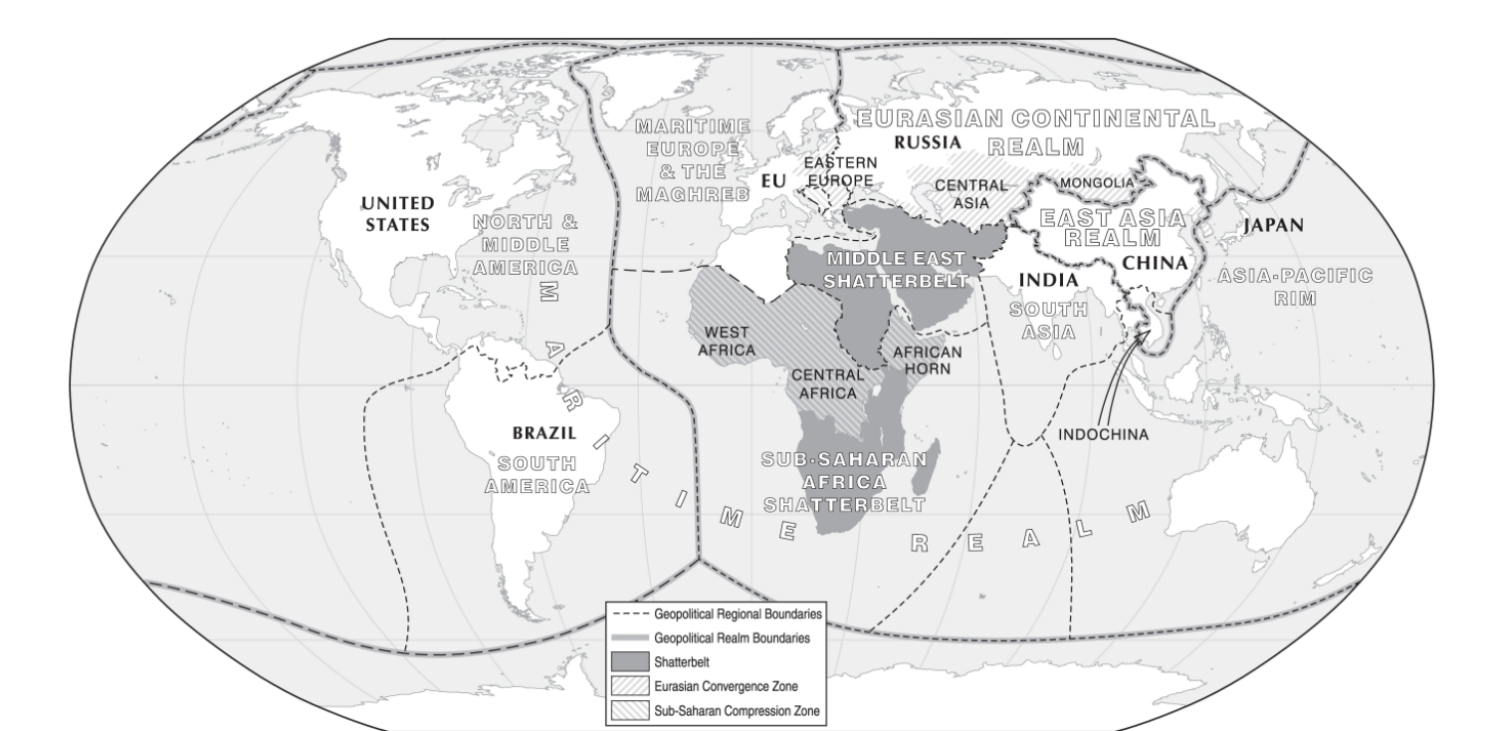
Cohen also developed the concept of Geopolitical structure, which divides the world into four distinct sectors based on shared characteristics. First sector, the Geostrategic Realms, comprises areas that enhance the projected power of major states and offer strategic advantages such as sea passageways. These realms can be divided into sea-based and land-based categories. There are three realms: the Atlantic-Pacific, the Eurasian Continental (Russian heartland) and the mixed continental-maritime East Asia. Second sector, the Geopolitical Regions, consists of subdivisions of realms, and some are located between or far away from them. Moreover, they shares many characteristics such as political interactions, and they are tactical nature, focusing on neighborhood-level interactions. The regions include: North and Middle America, South America, maritime Europe and the Maghreb, the Asia-Pacific Rim, the Heartlandic Russian, Central Asia, Trans-Caucasus, Mainland China and Indochina and South Asia. Third sector, the Shatterbelts, consist of deeply fragmented regions marked by persistent internal and external divisions where great-power competition constantly occur over control of resources and strategic locations. These conflicts often spread to neighboring states, causing regional or even global instability. The are two main shatterbelts: the Middle East and Sub-Saharan Africa. Finally, fourth sector, the Gateway States, includes countries that act as ‘bridges’ of the world, facilitating the flow of people, goods and ideas. They possess strategic location, specialized economies, and diverse cultural and political systems and an adaptable population; however, gateway states lack self-sufficiency and depend mostly on imports.
The Middle East as a Shatterbelt
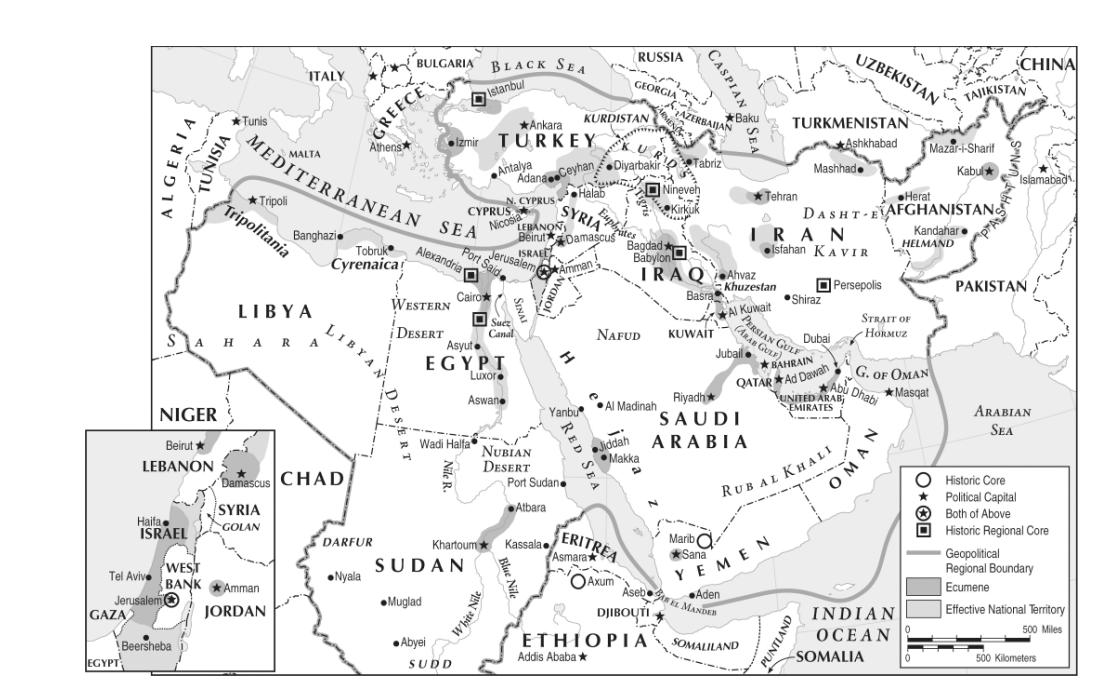
Before examining why Israel functions as a powerhouse in its region, the Middle East, it is proper first to consider the characteristics of the Middle East itself. Cohen defines this area as a ‘shatterbelt’ region. Historically and today, the Middle East has been a diverse religious and ethnic region, as well as by its vast reserves of natural resources and strategic location at the crossroads of Europe, Asia, and Africa. It is designated as a shatterbelt because of the continuous conflicts that have emerged throughout its history both within and between states. Prominent examples include the Arab-Israeli wars, the Arab Spring uprisings, and the spread of terrorism which eventually became a global phenomenon. It is also crucial to mention the constant intervention of global powers-for instance, the US and the USSR, and later Western powers against Iran, Russia and China-over the control and influence of strategic positions like Suez canal and the oil and gas resources the Gulf Sea.
Israel’s power features
Now it is time to examine more closely, but briefly, Isreal’s power features that enable it to be a powerhouse in its region. Throughout the period 1948-2025, Israel has been supplied constantly supplied with sophisticated military technology worth approximately $130 billion, by one the first-order states the US. Continuing, over the last 5 years (2020-2025), Israel’s annual military budget has been approximately more than $20 billion. In contrast with the defense budgets of its neighboring states, Isreal surpasses each of them numerically. Moreover, Israel has a force of approximately 670000 personnel, including reserves, 611 aircraft, 1000 tanks and an arsenal of 600 various artillery pieces. Although it has never officially admitted it, Israel is also believed to possesses roughly 90 nuclear warheads.
Additionally, Israel’s modern industry defense-roughly 600 to 700 firms with a workforce of around 100000-produces innovative systems for Israel, like UAVs, and C4ISR technologies. Israel’s industrial defense power is also evident in its arms exports. Between 2017-2022, Israeli arm exports ranged between $7 billion and $12.5 billion annually, making the country a global arm exporter, accounting for about 2.3% of the global total. However, Israel’s power is not based solely on its military and industries but also on its society and political leadership. The core beliefs of the Israeli population rest on family and community, where members support and stand by one another, on justice and dignity, deeply rooted in Jewish tradition, democracy-through organized elective government, and freedom of speech-and on patriotism, which fosters unity and loyalty in defending the Jewish state. Despite the plurality and ideological differences among Israel’s many political parties, when it comes to the survival and security of the state, all unite and support policies that ensure readiness to confront any existential threat.
Implementation of Cohen’s Theories in the Israeli case
In the case of Israel, it is clear how Cohen’s theoretical approach can be applied. Starting with the four pillars of power, militarily, Israel has developed unique technological systems like Iron Dome, which provides a defensive umbrella against both unconventional or conventional missiles threats from hostile actors, for example HAMAS and Iran. Continuing with the economic pillar, Israel projects its influence on other countries, through the diplomatic arms exports. More specifically, it has managed to sell across many regions, for instance Europe and Asia. Regarding ideological leadership, the Israeli people have shown throughout the period of the Arab-Israel conflicts (1948-ongoing) strong foundations of patriotism and democratic values-that provide them with the emotional will to protect their homeland. Finally, in terms of political cohesiveness, in every conflict against Israel, the political elite forms a national unity government to ensure stability and coherence.
For the hierarchical order of power, Israel can be identified as a second-order power with some aspects of a first-order power. This is because it can project power throughout its region, as shown by successive military operations against Hezbollah in 2023-2024 inflicting major blows through assassinations of its leadership, and by conducting surprise air and covert attacks on Iran that destroyed strategic facilities and killed high–ranking officers and nuclear researchers in the twelve-day war 2025. Beyond these events, Israel’s ability to provide arms and military expertise has allowed it to build alliances with neighboring states, like Cyprus and Azerbaijan, through the sale of Barak MX missile system. Additionally, pro-Israeli lobbies that promote favorable foreign policies for Israel exist within major powers like the US and the EU.
Geographically, Israel belongs to the shatterbelt region of the Middle East. Its strong democratic foundations and its ability to extract resources and transform into tools of power allow it to withstand the ongoing fragmentation of the region. Moreover, due to its coastal position in the Eastern Mediterranean and Red Sea-and as a junction point between three continents-Israel can be identified as a gateway state connecting the Western Alliance and the Eurasia realms and regions. Israel also has a diverse ethnic population and religions for example Arabs-Muslims and Israelis-Jews. A large portion of its citizens are highly skilled and employed in high-tech industries; however, the country lacks full-sufficiency because many components used in its industries are imported from abroad.
Conclusion
Based on Cohen’s approach, it is evident that Israel fits well into his overall theoretical framework, helping researchers and policymakers understand how vital Israel is to their foreign policies considerations. This can be summarized through the following points: four pillars of power, Israel’s strength is reflected in its advanced military technology, its economic influence through its arms exports, in ideological leadership, grounded in strong patriotic and democratic values, and political cohesiveness, as the political elite consistently unities to confront for existential threats. Additionally, Israel can be designated as a second-order power due to its ability to project both military and diplomatic influence across its regional domain. Furthermore, Israel also displays certain aspects of first-order power because of its powerful pro-Israeli lobbies within key states and alliances that shape more favorable policies for Israel, as well as through its geostrategic position as a gateway state offering a save entry and exit route for its allies.
Although Israel can be regarded as a powerhouse within its region and beyond, it must be remembered that it remains part of the Middle East shatterbelt. This fact is crucial, as the region has been plagued by ongoing conflicts, some of which have threatened to spill over into Israel. Moreover, many dictators, and extremist groups have used propaganda to gain support among Muslim-Arabs societies against the ‘Zionist regime’ which they accuse of seeking to create a Greater Israel and to exterminate Muslims-Arabs. Their propaganda also refers to the Palestinian question, an ongoing territorial conflict between Israelis and Palestinians that dates to 1948. Notable examples of these conflicts include the Arab-Israeli wars of 1948 and 1967, the recent border conflict against Hezbollah in 2023-2024, and the twelve-day war with Iran in 2025. Another issue is that Israeli, as a gateway state with a small territory and hostile neighbors, cannot fully sustain itself due to its limited natural resources. Its economy relies heavily on imports, making it vulnerable to sanctions-like the recent ones from certain Western allies due to the Palestinian conflict-and to naval blockades, as illustrated by Egypt’s closure of the Straits of Tiran in 1967. Finally, Cohen argues that this theoretical system is dynamic; therefore, while Isreal is a strong state within this hierarchical system of power, a new question arises for the future: how long can Israel maintain this position and deflect new threats that are seek to destroy it?
Bibliography
- Al Jazeera. “What Is the Israeli Unity Government and What Does It Want to Achieve?” October 13, 2023. https://www.aljazeera.com/news/2023/10/13/israel-unity-government.
- American Jewish Committee. “7 Things You Need to Know About Israel’s Iron Dome Defense System.” Accessed November 12, 2025. https://www.ajc.org/news/7-things-you-need-to-know-about-israels-iron-dome-defense-system.
- Arad, Uzi, and Gal Alon. Patriotism and Israel’s National Security: Herzliya Patriotism Survey 2006. Herzliya: Institute for Policy and Strategy, Lauder School of Government, Diplomacy and Strategy, 2006.
- Axios. “What to Know About Israel’s Military Strength.” October 21, 2023. https://www.axios.com/2023/10/21/israel-military-capabilities-explained.
- Cohen, Saul Bernard. Geopolitics: The Geography of International Relations. 3rd ed. Lanham, MD: Rowman & Littlefield, 2015.
- Evron, Yoram. “Israel’s Defence Industry: Adaptation and Growth in a Changing Arms Market.” Defence Studies 25, no. 2 (2025): 301–321. https://doi.org/10.1080/14702436.2025.2472720.
- Global Firepower. “2025 Israel Military Strength.” Last reviewed January 9, 2025. https://www.globalfirepower.com/country-military-strength-detail.php?country_id=israel.
- Kambas, Michele. “Cyprus Takes Delivery of Air Defence System from Israel, Report Says.” The Times of Israel, December 5, 2024. https://www.timesofisrael.com/cyprus-takes-delivery-of-air-defense-system-from-israel-report-says/.
- Knesset. “The State Budget in Numbers – BudgetInfo8.” Accessed November 12, 2025. https://main.knesset.gov.il/en/about/pages/budget/budgetinfo8.aspx.
- Kristensen, Hans M., and Matt Korda. “Israeli Nuclear Weapons, 2021.” Bulletin of the Atomic Scientists 78, no. 1 (2022): 38–50. https://doi.org/10.1080/00963402.2021.2014239.
- Legorano, Giovanni. “Israel Can’t Survive Autarky.” Foreign Policy, October 7, 2025. https://www.foreignpolicy.com/2025/10/07/israel-autarky-netanyahu-economy-defense-gaza/.
- Macrotrends. “Israel Military Spending/Defense Budget.” Accessed November 12, 2025. https://www.macrotrends.net/global-metrics/countries/isr/israel/military-spending-defense-budget.
- Mauzé, Grégory. “Israeli Networks of Influence in Brussels: Behind the Scenes.” Orient XXI, January 31, 2019. https://www.orientxxi.info/magazine/israeli-networks-of-influence-in-brussels-behind-the-scenes,2886.
- Mearsheimer, John J., and Stephen M. Walt. The Israel Lobby and U.S. Foreign Policy. Cambridge, MA: John F. Kennedy School of Government, Harvard University, Working Paper RWP06-011, March 2006.
- Sarukhanyan, Vahe. “Israel to Sell Updated Air Defense System, Satellites to Azerbaijan.” Hetq, December 7, 2023. https://www.hetq.am/en/article/162596.
- U.S. Department of State. “U.S. Security Cooperation with Israel.” Accessed April 25, 2025. https://www.state.gov/u-s-security-cooperation-with-israel.
Acknowledgment
This paper was polished using two AI-based tools, ChatGPT and Grammarly, exclusively for improving grammar, spelling, and punctuation. These tools were not used to influence the content, analysis, or conclusions of the study.

