Theory of Sea Power, Case Study: Turkey
- Political Analysis
Ioakeim Ioakeim
- 0
- 22 minutes read
Abstract
The main research question of this paper is to explain, using Alferd Mahan’s Theory of Sea Power, how Mavi Vatan functions and helps Turkey increase its maritime power in the Eastern Mediterranean Sea (EMS) during the period 2016–2025. The year 2016 was selected as the starting point because, following the failed coup of 15 July, the Turkish leadership developed mistrust toward its Western allies and subsequently adopted a more independent foreign policy approach, distancing itself from Western influence. This new direction, chosen by the Turkish elite, represented a clear message of a broader strategic plan—one in which Turkey seeks to become an autonomous regional power. The methodological approach of this document is based on Mahan’s Theory of Sea Power, focusing mainly on its six elements to identify whether Turkey is on a path to becoming a sea power capable of controlling the EMS. Although the Theory of Sea Power originally refers to states seeking global domination through control of the sea, the six elements can help researchers identify whether countries with mid-size capabilities are also trying to increase their regional dominance by applying the same maritime strategies.
While Turkey has already expanded into other maritime theaters, such as Somalia, the focus of this study is the EMS due to its continuously changing dynamics. Additionally, the paper uses a broad range of primary sources such as official government reports, and secondary sources, for example, journal articles and pieces from mainstream media, which are cross-checked with other materials to avoid misinformation. Moreover, the study uses diverse sources originating from Turkey, Cyprus, and other international contexts. The text is divided into five parts: 1)Introduction, 2)Mahan’s Theory Explanation, 3)Mavi Vatan – Blue Homeland, 4)Implementation of the Theory of Sea Power to Mavi Vatan, and 5)Conclusion.
1.Introduction
Nowadays, the importance of the EMS has increased significantly; besides being a global communication and economic hub that connects Europe, Asia, and Africa through the Suez Canal and the Turkish Straits, its importance has grown even more in the last decade due to the discovery of hydrocarbon resources. Also, the last decade has been marked by diplomatic tensions and conflicts in the EMS. Issues such as terrorism and civil wars have re-emerged, threatening not only regional but also global stability. One of the many challenges that the countries of the region, along with their wider alliances, are facing is the rise of a revisionist Turkey. More precisely, the Turkish leadership is seeking once again to become a regional power and a key actor in the EMS. This indicates that Turkey is pursuing new strategies to increase its power and influence over its former Ottoman provinces. One of the strategies currently adopted by the Turkish leadership is the re-establishment of its presence in what historians once called the ‘Ottoman Lake’, meaning the EMS. The maritime dogma that helps Turkey align its strategic goals is the so-called Mavi Vatan.
2.Mahan’s Theory Explanation
First and foremost, it is essential to present the core ideas of the Theory of Sea Power, specifically the six elements that Mahan introduced in his book The Influence of Sea Power upon History, 1660–1783. According to Alferd, these six elements form a grand naval strategy that constitutes the foundation for maritime dominance; hence, a sea power state can achieve global influence. Firstly, geographical position refers to the natural advantages of a country. States with good access to the oceans and strategic trade routes can develop strong offensive and defensive capabilities. Secondly, physical conformation means that to enhance maritime activity, states must possess a sea environment that supports their naval strength — for example, access to shipbuilding materials, natural harbors, and productive coastlines. Thirdly, extent of territory emphasizes that coastlines should have sufficient length for commercial use and be easily defensible, while the possession of colonies and overseas bases can further strengthen a nation’s naval power. Fourthly, size and character of population, stresses that a country must be large, industrious, and sea-minded. A sizable population can support not only commercial industry but also the maintenance of a strong naval fleet. Fifthly, national character refers to the population’s engagement with trade, enterprise, and adventure — factors that help expand a nation’s global influence and maritime traditions. Finally, the character and policy of governments, require that political leaders and policymakers continuously promote naval policies, such as shipbuilding and maritime investment. Without such policies, a state’s sea power capabilities will inevitably weaken.
3.Mavi Vatan – Blue Homeland
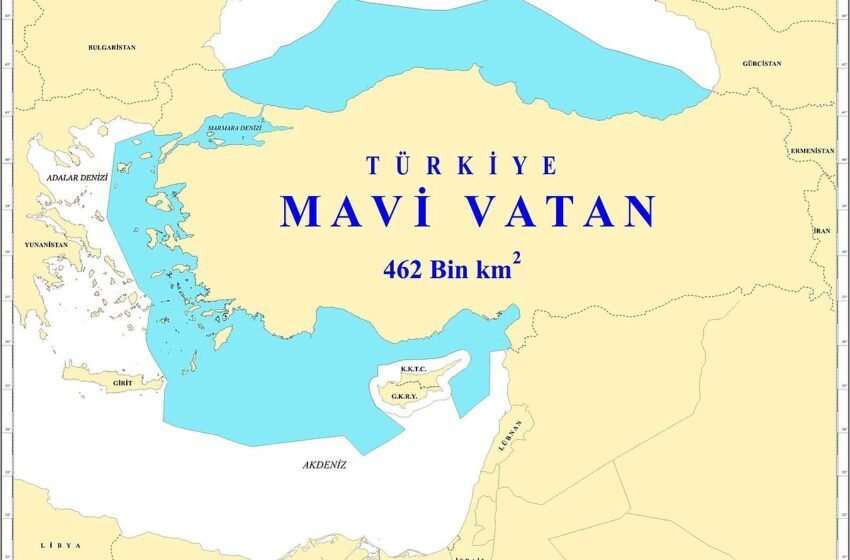
Moving to the next part of the text, here is the explanation and origin of Mavi Vatan and how Turkey is currently applying it. This phrase is in the Turkish language: ‘Mavi’ means blue and ‘Vatan’ is translated as homeland. In short, Blue Homeland is a strategic dogma constructed and promoted across all Turkish sectors — mainstream media, academia, the political elite, and policymakers — by a group of Turkish Navy officers. This doctrine was developed in response to a published article on the EU’s maritime borders, the so-called Map of Seville, by two geographers from the University of Seville. The map presented the Member States’ Exclusive Economic Zones (EEZs) and recognized Cyprus’s territorial claims within its EEZ. The release of this map triggered strong criticism in Turkey, especially from the military. More specifically, in response to this map, Admiral Cem Gürdeniz, during a Turkish Naval Symposium in 2006, mentioned for the first time the doctrine of Mavi Vatan, which was intended to secure the strategic naval interests of Turkey. After this incident, many naval officers began using the term and published various works related to the Mavi Vatan doctrine, for example, Cihat Yaycı. The concept gained even greater popularity when a large-scale naval exercise, named Mavi Vatan 2019, was conducted across the entire maritime territory of Turkey.
But what does this doctrine claim? First, its supporters argue that to defend the homeland, one must first defend it from the sea. Secondly, they claim that many Greek islands located near Turkey lie on the Anatolian continental shelf rather than the Greek one. Therefore, these islands should not possess EEZs, and their maritime areas should instead belong to Turkey’s naval domain. Here It must be noted that the Montego Bay Convention favors inhabited islands by granting them 12 nautical miles each for their EEZs—resulting in 70–75% total control of the Aegean Sea by Greece. Consequently, within the Turkish mindset, the Aegean Sea would effectively become a ‘Greek lake’, restricting Turkey’s commercial and naval fleet to its Western shores. Moreover, Turkey has never signed this treaty, which allows it to openly disagree with the Convention and demand more EEZs.
It is also important to clarify that, based on Turkey’s claims, it does not seek the annexation of the Greek islands but rather the annexation of the surrounding sea. Additionally, the doctrine calls for the demilitarization of the islands of Limnos and Samothraki, with some of its supporters advocating for the further demilitarization of additional islands. Furthermore, this doctrine aims to geographically divide Turkey’s main regional competitors in the EMS—Greece and Cyprus. If these states manage to extend their 12 nautical miles and connect their EEZs, Turkey will effectively become a landlocked nation confined to its Antalya shores. This explains its 2019 decision to sign a memorandum of understanding with Libya, creating shared EEZs that overlap with the already established EEZs of Greece and Cyprus—thus generating new diplomatic tensions with Greece, Cyprus, and the European Union. Finally, to illustrate the broader context, Turkey is actively claiming that approximately 462,000 km² belong to its EEZ.
For sea, domination Mavi Vatan influences the mindset of Turkish elite toward being expansionist in the seas. That’s why Turkey has since boosted its military capabilities by investing in naval military programs, demonstrating its power in disputed areas and constructing new overseas bases across the EMS. To give some examples, the Turkish naval program MILGEM– a program that focuses on the construction of more national warships. This program led to the construction of different types of naval ships with the most prominent being the flagship of the Turkish fleet TCG Anadolu in 2023 (a drone-carrying amphibious assault ship). The escort of research and seismic vessels like Yavuz (2018) and Oruç Reis (2020) in Cypriot and Greek claim EEZs prompted an alarm and diplomatic tensions between those states. Moreover, Turkey managed to reconstruct and develop more naval and air bases, in North Cyprus–Lefkoniko and Bogazi (2025), and in Libya Al-Watiya and Misrata (2019).
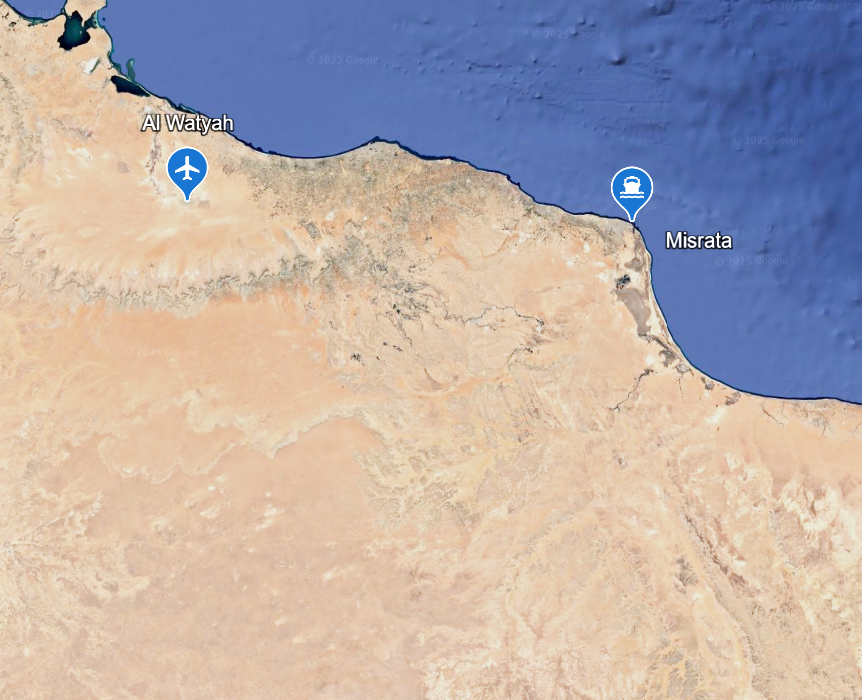 Turkish Bases in Libya Turkish Bases in Libya |
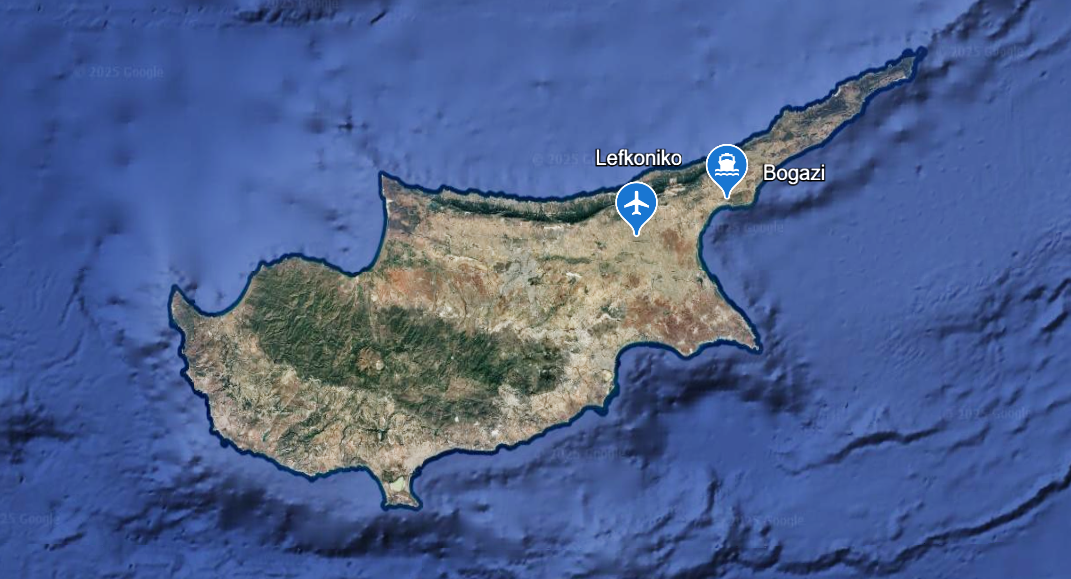 Turkish Bases in Cyprus Turkish Bases in Cyprus |
<br>4.Implementation of the Theory Sea Power to Mavi Vatan
In this part, the six elements of Mahan are applied respectively to the ideology of Mavi Vatan. Starting with the geographical position, Turkey has approximately 8,000 km of coastline and borders the Black Sea, the Sea of Marmara, the Aegean Sea, and the EMS. Additionally, Turkey controls some of the most vital strategic straits on the European continent—the Bosporus and Dardanelles Straits. Moreover, besides its maritime borders, Turkey also serves as a bridge between Europe, the Middle East, and Asia. Continuing to the physical conformation, Turkey possesses a significant number of different types of coastal structures, such as shipyards. Furthermore, it has many natural harbors and organized ports along its entire coastline, including Samsun (Black Sea), Ambarlı (Sea of Marmara), Aliağa (Aegean Sea), and Mersin (Mediterranean). Regarding the extent of territory, Turkey has reconstructed and developed overseas naval and air bases in the EMS, specifically in Cyprus and Libya. Moving to the next element, the size and character of the population, Turkey has a population of more than 85 million and a merchant fleet of roughly 2,150 vessels (51.9 million deadweight tons of capacity). As for the national character, a large portion of the Turkish population is employed in the maritime sector, with around 140,000 people working as seafarers and roughly 94,000 employed in shipyards. Finally, concerning the character and policy of governments, it must be mentioned that the current administration, during the period 2002–2025,has invested roughly 300 billion dollars in transport and communications, with a significant portion allocated to improving maritime infrastructure—for example, the modernization of shipyards. Another notable government program is the MILGEM project, which, as a state initiative, has produced a significant number of newly modernized naval ships, such as the 4th I-class frigate TCG Içel (F-518).
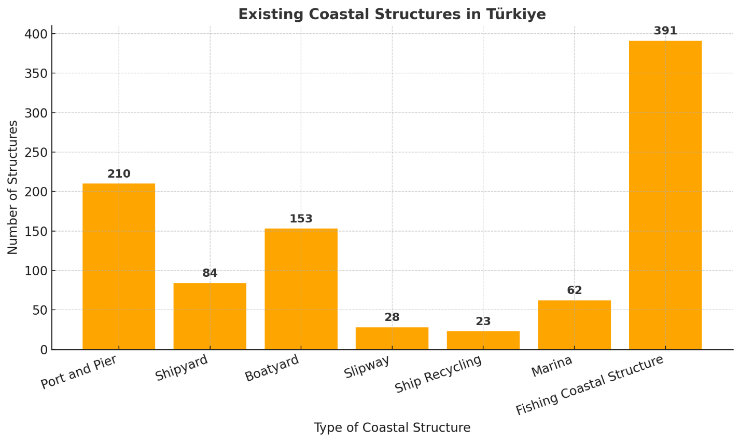 Numbers of Structures and Type of Coastal Structure Numbers of Structures and Type of Coastal Structure |
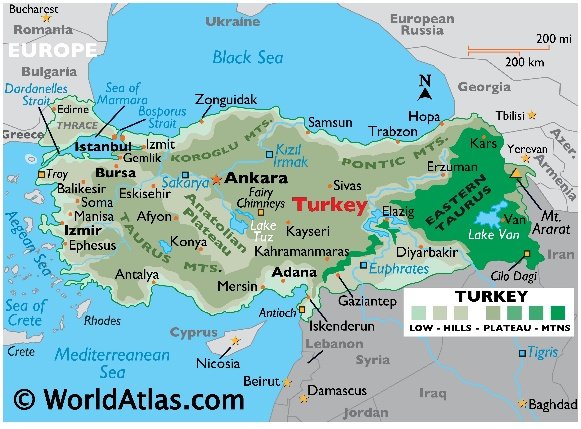 Physical Map of Turkey Physical Map of Turkey |
Conclusion
In the broad context of the new strategies that Turkey seeks to impose in the EMS, it is evident that Mahan’s Theory helps to better understand the doctrine of Mavi Vatan. More precisely, the six elements can be briefly identified as follows: 1)geographical position, referring to Turkey’s location across three seas, its control over the Turkish Straits, and its role as a physical bridge between regions, 2)physical conformation, which includes a significant number of various coastal facilities, 3)extended territory referring to its overseas bases, 4)size and character of population with 85 million people and the 11th largest global merchant fleet, 5)national character as almost 234,000 individuals are involved in maritime activities, and 6)character and policy of governments reflected in investments of billions of dollars in maritime infrastructure and the naval military budget. In addition, the theory sufficiently explains Turkey’s hostile approach toward its neighbors, as the six elements provide Turkey with a combination of sea power that enables it to project its strength and adopt a more aggressive stance. This gives Turkey the opportunity to pursue two main goals: first, to prevent the axis of Cyprus and Greece from forming their EEZs—thus avoiding being locked within its coastline—and second, to steadily increase its power over the EMS. However, the ambition of transforming the EMS to an ‘Ottoman lake’ may be unrealistic due to different internal and external causes some of them can be mentioned briefly: Western bloc (e.g. USA-EU) regional countries (Egypt-Israel) are not going to leave Turkey unchecked, and the serious long-term economic crisis and political instability that appears in the country also hinder this ambition.
Bibliography
- Bahtić, Fatima. ‘Türkiye Launches New İstif-Class Frigate.’ Naval Today, September 8, 2025. https://www.navaltoday.com/2025/09/08/turkiye-launches-new-istif-class-frigate/
- ‘Blue Homeland (Mavi Vatan).’ Wikipedia. Last modified October 30, 2025. https://en.wikipedia.org/wiki/Blue_Homeland_(Mavi_Vatan)
- Directorate General for Maritime Affairs. ‘Türkiye: a Maritime Nation.’ Accessed October 31, 2025. https://maritime.uab.gov.tr/council
- ‘Focus Business Türkiye.’ Republic of Türkiye, Ministry of Trade, Directorate General of Exports. July 2025.
- Gürcan, Efe Can. ‘A Neo-Mahanian Reading of Turkey and China’s Changing Maritime Geopolitics.’ BRIQ: Belt & Road Initiative Quarterly 2, no. 1 (Winter 2020–2021): 23–35.
- Kardaş, Tuncay. ‘Mavi Vatan: The Origins and Development of Turkey’s New Maritime Strategy.’ Insight Turkey 23, no. 3 (Summer 2021): 59–76.
- Kıyak, Figen. ‘The First ‘National Ship’ of Turkey: MiLGEM Project.’ Navalium, January 5, 2020. https://navalium.com/the-first-national-ship-of-turkey-milgem-project/
- Les Clés du Moyen-Orient. ‘Türkiye, the New Regional Power in Africa (3/3): A Military Presence That Is Now.’ https://www.lesclesdumoyenorient.com/Turkiye-the-new-regional-power-in-Africa-3-3-A-military-presence-that-is-now.html
- Mahan, Alfred Thayer. The Influence of Sea Power upon History, 1660–1783. Boston: Little, Brown and Company, 1890. Project Gutenberg eBook, released September 26, 2004.
- Nugent, Bob. ‘The MILGEM Programme: Turkish Naval Procurement and Exports.’ European Security & Defence, May 31, 2023. https://euro-sd.com/2023/05/articles/31367/the-milgem-programme-turkish-naval-procurement-and-exports/
- Özberk, Tayfun. ‘Türkiye Launches 4th I-class Frigate, the Future TCG İçel (F-518).’ Naval News, September 2, 2025. https://www.navalnews.com/naval-news/2025/09/turkiye-launches-4th-i-class-frigate-the-future-tcg-icel-f-518/
- Stamouli, Nektaria. ‘Turkish Ship Resumes Energy Search in Waters Claimed by Greece.’ POLITICO, October 12, 2020. https://www.politico.eu/article/turkish-ship-resumes-energy-search-in-waters-claimed-by-greece/
- ‘Türkiye’s Drone Carrier Can Sail Istanbul–New York Roundtrip without Refuelling.’ Daily Sabah, August 29, 2025. https://www.dailysabah.com/business/defense/turkiyes-drone-carrier-can-sail-istanbul-new-york-roundtrip-without-refueling
- Turkish Chamber of Shipping. Maritime Sector Report: Istanbul & Marmara, Aegean, Mediterranean, and Black Sea Regions. Istanbul: Turkish Chamber of Shipping, 2025.
- ‘Turkey Draws EU Ire for Drilling off Cyprus’ Coast.’ DW (Deutsche Welle), June 20, 2019. https://www.dw.com/en/turkey-draws-eu-ire-over-oil-drilling-off-cyprus-coast/a-49285001
- ‘Turkey Maps & Facts – World Atlas.’ World Atlas. Accessed October 31, 2025. https://www.worldatlas.com/maps/turkey
- ‘Turkey Treats Occupied Cyprus as Expanded Military Base.’ in-Cyprus / Phile News, October 5, 2025. https://in-cyprus.philenews.com/local/turkey-military-base-occupied-northern-cyprus-expansion/
Acknowledgment
This paper was polished using two AI-based tools, ChatGPT and Grammarly, exclusively for improving grammar, spelling, and punctuation. These tools were not used to influence the content, analysis, or conclusions of the study.

